Calm Advertising – Position Paper

After a fruitful discussion at the Pervasive Advertising Workshop on May this year, I hope to continue the diaologue on Calm Advertising next Friday at the Informatik 2009 conference.

As I wrote earlier about the first Workshop on Pervasive Advertising:

“The workshop topic inspired us to develop a concept of “Calm Advertising” that refers to the vision of “Calm Computing” and focuses on a new way of public advertising that doesn`t aim to shout out lout messages to get peoples attention but enable passers-by to freely engage in the communication with advertising companies.”

Economy-of-Engagements

Figure 1: Influence of Attention and Engagement [according to 4]

Continue reading ‘Calm Advertising – Position Paper’

Book presentation / Buchpräsentation

In the following weeks I will present the contents of my books “Interactive Displays in Public Space” at the following two events in Germany and Switzerland.

Please, let me know any questions, special interests etc. in advance.

Evaluating Interaction with Display Applications in Public Space

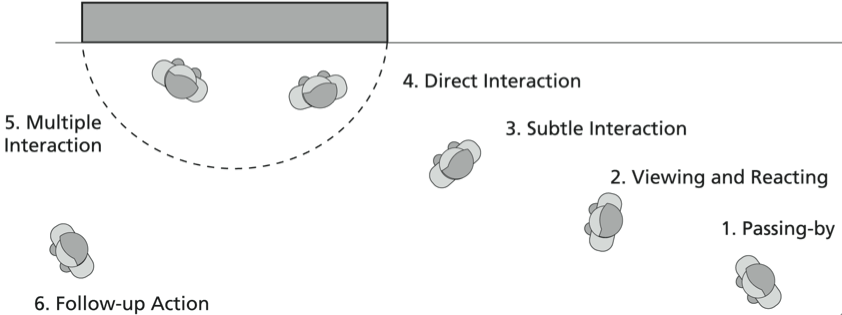
As published ealier in this blog, interactive display analysis has already yielded data related to the public use of and interaction with displays. In order to develop a ”Framework for Evaluating Interaction with Multi-Display Applications in Public Space”, I expanded the previous post.

Initial investigations of public interactions with large-scale displays can provide valuable insights into the process of usage and interaction. As a starting point Brignull and Rogers divide this process in their “two-thresholds framework” into peripheral, focused activities, and direct interaction (1). In a similar approach, Vogel and Balakrishnan’s “four-phase framework” differentiates between ambient display, implicit, subtle, and direct interaction (3). Last but not least, Streitz et al.’s “three-phase framework” focuses on the areas in which interaction takes place rather than the interaction process itself. (2).

Continue reading ‘Evaluating Interaction with Display Applications in Public Space’

Calm Advertising?

See below Miriam Meckel’s and my presentation from the Pervasive Advertising Workshop at PERVASIVE 09:

The workshop topic inspired us to develop a concept of “Calm Advertising” that refers to the vision of “Calm Computing” and focuses on a new way of public advertising that doesn`t aim to shout out lout messages to get peoples attention but enable passers-by to freely engage in the communication with advertising companies.

I am working on a position paper that I will post here. D.M.

Proceedings Pervasive 2009 Workshop

The Proceedings of the Pervasive Advertising Workshop at Pervasive 2009 are now online.

Book Preview at Google Books

I just came across my book “Interactive Displays in Public Space – A theoretical analysis of intrinsically motivating design elements” at Google Books (only in German language).

English Abstract:

“Interactive large format displays have presently found their way into many places in public space. After a long phase of experimenting with prototypes only recently have technically mature applications been observed that are used in an increasing number of potential areas. This dissertation examines the motivations behind the use of these applications.

Serving as the point of departure are four large format displays of the installation Magical Mirrors, developed as prototypes by the author of this work, and which allowed the first experiences with the use of interactive large format displays in public space to be collected even before the beginning of the investigation. These initial experiences were taken into consideration in developing the research questions and design.
At the center of the work is an analysis of theoretical motivations in which five motivational factors are determined according to previous research work and in consideration of the demands specific to interactive large format displays. In the analysis of these factors a set of tools of fundamental motivations are identified from which design elements for interactive large format displays in public space can be derived. The results of the analysis are subjected to an empirical examination. In 15 partial experiments the observed user behavior of a total of 4640 passersby is analyzed.
On the basis of this empirical investigation this dissertation presents – as one of the first scholarly works in this area – a contribution to the understanding of the fundamental motivations behind the use of interactive large format displays in public space.”

Interactive Displays 2009 – Free Pass Winner

As announced earlier, IntertechPira offered one free pass to attend the Interactive Displays 2009 conference in San Jose, CA. The winner of this “lottery” is Pablo Jenner Paredez Angeles.

Buchveröffentlichung / Book available


Today, my dissertation:

“Interaktive Großbildschirme im öffentliche Raum: 
Nutzungsmotive und Gestaltungsregeln”

was published here

To get an overview on the content you can download the index of contents at GABLERS official website.  

As mentioned earlier it is in German only but I invited to publish english papers at Pervasive 09 (Workshop Pervasive Advertising) and EuroITV 200 (Workshop ”Designing and understanding enjoyable media experiences“).

Public Displays: Research Limitations

More and more academic research projects are starting to explore the usage of interactive displays in public space but until today there are three central limitations in this area of investigation:

Limitation 1: There are merely empirical investigations

The vast majority of research projects with interactive displays in public space is based on explorative investigation only. Most projects analyze the spread large-scale displays in public space from a very generic perspective, raise general non-systematic questions and offer only hypothetic answers. The entry of interactive applications into public space is part of a greater tendency: computer usage has seeped into public life and is no longer restricted to mere task fulfillment at the workplace. While task oriented theories simply regard the “how” of an activity but not the “why”, they leave questions concerning underlying motivations unanswered. Presently there exists a significant need for furthering the understanding of motivations behind user activities. Only very little is known about the process of interaction and particularly, about how interactive displays activate engagement of passers-by and encourage intensive user-interaction.

Limitation 2: Real-world studies are needed to fully understand public interaction processes. Continue reading ‘Public Displays: Research Limitations’

Pervasive Advertising: Why Do We Want to Interact With Electronic Billboards in Public Space?

At the Pervasive Advertising Workshop at Pervasive 2009 I will try to give an answer to the question: Why Do We Want to Interact With Electronic Billboards in Public Space?. 

In our paper, Miriam Meckel and I examine the motivations behind the use of interactive large format displays in public space. On the basis of the empirical investigation documented in this blog we present an analysis of user-motivations in which motivational factors are determined from which design elements for interactive large format displays in public space can be derived. 

daniel-michelis_direct-interaction2

Fig. 1: Usage patterns of passers-by interacting with the prototype

Next Page »


Interaktive Großbildschirme im öffentlichen Raum (Amazon Link)

Selected Pictures

Interactive Displays in Public Space

Interactive Displays in Public Space

Magical Mirrors - Interactive Displays in Public Space

Magical Mirrors - Interactive Displays in Public Space

Magical Mirrors - Interactive Displays in Public Space

More Photos


November 2009
M T W T F S S
« Sep    
 1
2345678
9101112131415
16171819202122
23242526272829
30  

Categories